Many cash game regulars spend five hours a week analyzing complex solver trees just to squeeze out an extra 0.5 EV-bb/100 against tough opponents.
Yet, when they boot up their poker client, they take a seat at the first open table they see - joining a lineup of five competent, balanced regulars.
This is a massive operational blunder.
Game selection is not a lazy shortcut; it is the single highest-leverage strategic skill in poker.
An average player who sits at a soft table with two recreational players will print a significantly higher hourly win rate than a world-class player sitting in a line-up of five high-stakes regulars.
If you want to maximize your hourly earnings and reduce your variance, you must treat table selection as a mandatory technical discipline.
The Hard Math of Game Economics
Poker is not a zero-sum game; because of rake, it is a negative-sum game.
In online 6-max cash games, rake extracts anywhere from 3 to 5 bb/100 out of every pot. If six solid regulars of equal skill sit at a table together, every single player at that table will lose money over a large hand sample due to rake friction.
Profit in cash games comes from one source: Opponent Errors.
Your win rate is directly proportional to the magnitude and frequency of the mistakes made by the players at your table.
- Against competent regulars: Errors are small, rare, and require complex multi-street exploits to extract fraction of a big blind.
- Against recreational players: Errors are massive, frequent, and blatant (e.g., calling 3-barrel bluffs with bottom pair, limping 40% of hands, or paying off geometric river overbets).
If your table does not contain at least one major target making high-frequency errors, you are in a low-EV or negative-EV game.
The 3 Rules of Optimal Seating Position
Finding a soft table is only half the battle. Where you sit relative to the recreational player determines how much of their money ends up in your stack.
In 6-max cash games, money flows clockwise around the table. Follow these three positioning rules:
Rule 1: Direct Position on the Recreational Player (The Gold Standard)
Always aim to sit directly to the left of the recreational player (in position). This allows you to isolate their limps, control pot sizes postflop, and value-bet them mercilessly without other regulars interfering.
Rule 2: Passive Regs on Your Left
Having tight, passive regulars sitting to your left is ideal. They fold to your blind steals at a high frequency, rarely 3-bet your open raises, and give you complete freedom to attack the recreational player without constant aggression behind you.
Rule 3: Avoid the "Reg Sandwich"
Never take a seat where a weak player is on your left while aggressive, tough regulars sit to your right. You will constantly be forced to play bloated pots out of position while the regulars behind you re-raise and squeeze your isolation attempts.
📥 Elevate Your 6-Max Cash Game Strategy
Enjoying this chapter breakdown? Join 1,000+ cash game players receiving weekly postflop solver analyses, exploitative heuristics, and mental performance protocols directly in their inbox.
Lobby Management: Identifying Exploitative Targets
To execute game selection efficiently, you need clear criteria for identifying high-EV tables in your client lobby before taking a seat:
- VPIP > 30%: A player voluntarily putting money into the pot on more than 30% of hands preflop is playing far too wide, creating massive postflop equity imbalances.
- Non-Full Stack Sizes: Recreational players rarely auto-rebuy. A player sitting with 40bb, 65bb, or 82bb is almost always a target player.
- Limping Statistics: Regulars almost never limp preflop. Seeing a player limp from early or middle position is an instant indicator of a weak, recreational target.
The "When to Leave" Protocol
The hardest part of game selection for most regulars is standing up from a game once it deteriorates.
Ego often tricks players into staying at a table: "I've been playing at this table for an hour, I don't want to lose my seat," or "I want to win my money back from this reg who just stacked me."
Staying at a table that no longer contains a clear target drains your win rate and burns valuable cognitive energy. Implement this mandatory rule:
The 3-Minute Stand-Up Rule: As soon as the main recreational player leaves the table or busts their bankroll, give yourself three minutes to evaluate if another target is sitting. If no weak player remains, stand up immediately.
Do not trade hands with regulars out of pride. Close the table, open the lobby, and migrate your capital to a higher-EV lineup.
The Actionable Shift: The "Lobby-First" Habit
For your next playing block, spend the first 5 minutes of your session scanning lobbies rather than auto-joining tables.
Rank every table on a simple 1-to-3 scale:
- Grade A Table: Direct position on a loose recreational player with passive regs on your left.
- Grade B Table: One recreational player present, but you are out of position.
- Grade C Table: Five regulars trading small edges.
Rule: Never play a Grade C table. If no Grade A or B tables are active, open fewer tables or spend that time studying until high-EV seats open up.
Ready to Turn Strategy into EV at the Tables?
Mastering game selection ensures that every hand you play yields maximum financial return for your cognitive effort. Combining smart table economics with a dominant, solver-backed framework is how you crush 6-max cash games systematically.
If you are ready to stop guessing postflop, master simplified GTO heuristics, and crush real-world opponents, step into the full Cash Game Hero Blueprint 2.0.
- 40+ Hours of Step-by-Step Video Modules
- Custom Solver Ranges & Exploit HUD 2.0 Setup
- Comprehensive Mental Game Protocols & Live Hand Analysis
About the Author
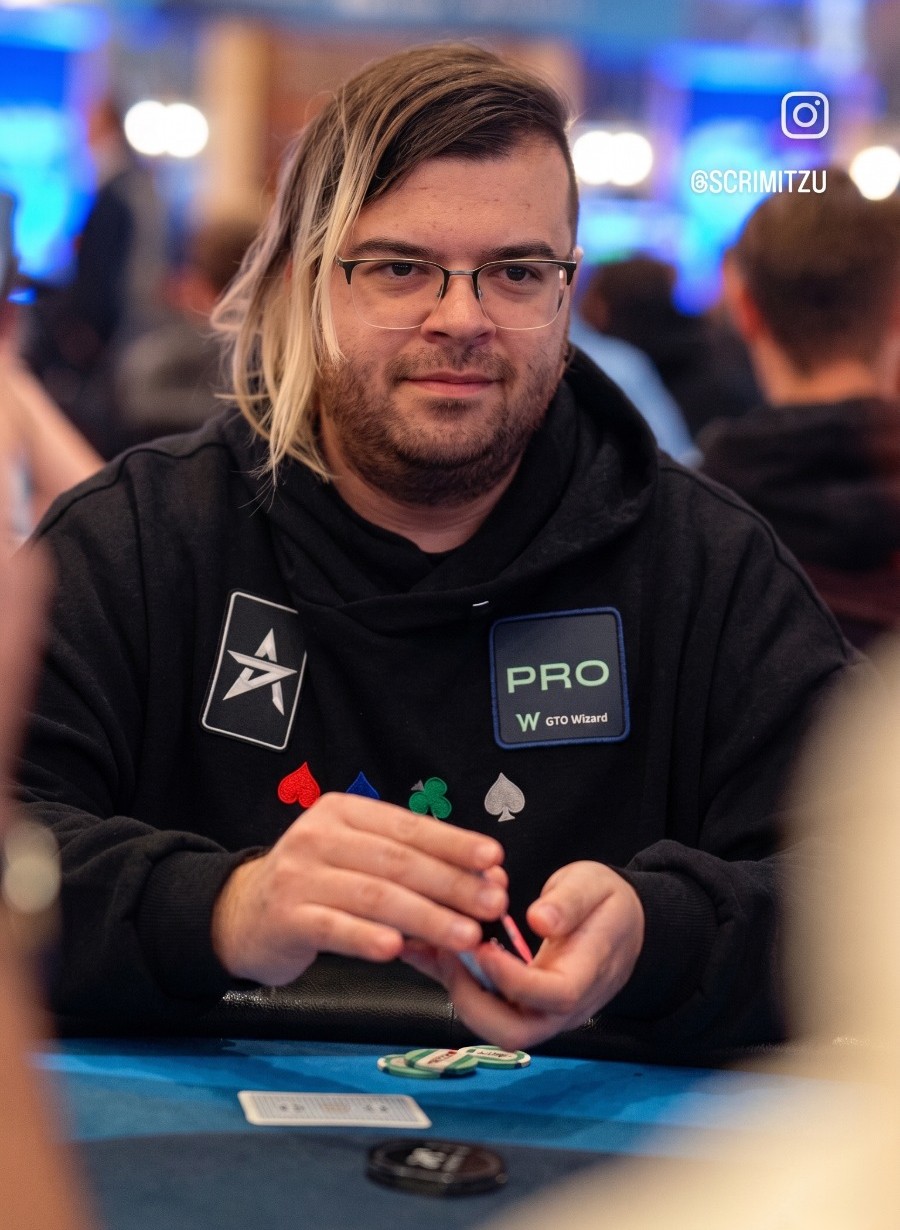
Scrimitzu is a professional poker player and coach with 17 years of experience and more than 10 million online hands played. He has coached over 500 players worldwide and is an official GTO Wizard coach and ACR Poker Team Online member.