The most dangerous label you can slap on yourself in poker is "Good Player."
On the surface, this seems like the entire objective. You want to be a Good Player. You want to be a Crusher. You want to be the smartest player at the table.
However, the moment you attach your identity to being "Good," you inadvertently build an invisible cage for yourself.
When you identify as "The Smart Kid" or "The Good Reg," every mistake becomes a direct threat to your self-image. If you make a bad call or lose a pot, you aren't just a player who made an error; you feel like a fraud. The reality of variance and human error contradicts your fragile identity.
To protect that identity, your brain subconsciously enters Preservation Mode:
- You avoid tough, high-stakes lineups because losing would mean you aren't "good."
- You stick strictly to "standard" lines because you are terrified of making a play that looks stupid to your peers.
- You stop asking strategic questions because you feel you should already know the answer.
The "Good Player" plateaus at the exact stake where they can comfortably defend their ego. They refuse to climb higher because climbing higher means risking failure.
The "Learner" Identity: Building an Antifragile Mindset
The highest-performing players in modern cash games do not view themselves as experts; they view themselves as Learners.
For a Learner, a mistake is not a character flaw or a blow to self-esteem. It is simply an invaluable data point.
How Identity Dictates Strategic Growth
The "Good Player" Mindset:
- Gets stacked and thinks: "I can't believe I played that so badly. Everyone at the table is judging me."
- Defends past strategic choices to protect their status.
- Seeks out easy games solely to validate their ego.
The "Learner" Mindset:
- Gets stacked and thinks: "Interesting. My heuristic for this specific spot was wrong. Time to run a sim and update the model."
- Treats every hand as a neutral scientific experiment.
- Seeks out tough games because that is where the highest-ROI lessons live.
The Learner is antifragile. They are completely willing to be the "worst" player at a tough table today so they can be the absolute best player at that table next year.
GTO Robot vs. Action Facilitator: The Ego Play Trap
There is another severe trap in trying to look "Good": the obsession with playing line-approved, solver-perfect poker just to look smart.
Modern cash game strategy is heavily influenced by GTO (Game Theory Optimal) solvers. Players get obsessed with finding the "approved" line so that if they posted the hand history to a Discord group, everyone would nod and say, "Standard."
Your job is not to impress a study group. Your job is to maximize EV and make money.
Sometimes, the most profitable exploitative play looks "bad" on the surface.
- The Ego Play: You check-raise a turn with a perfectly balanced range because the solver dictates it. A passive recreational player folds, and you win a small pot. You played "correctly," but left massive EV on the table.
- The Money Play: You lead into a recreational player for 20% pot - a sizing a solver would hate - because you know it triggers their curiosity and forces them to call with a wide, weak range. You are playing "badly" according to theoretical standards, but you are printing money.
In live and online cash games, your role is to facilitate the action.
Sometimes you need to make a slightly suboptimal play to keep a weak player engaged, happy, and rebuying. The "Good Player" refuses to do this because it hurts their ego. The Facilitator understands that keeping the game ecosystem healthy is worth infinitely more than a fraction of a big blind.
📥 Elevate Your 6-Max Cash Game Strategy
Enjoying this mental game breakdown? Join 1,000+ cash game players receiving weekly postflop solver analyses, exploitative heuristics, and mental performance protocols directly in their inbox.
The Superpower of Looking Stupid
The ultimate strategic freedom in poker is the willingness to look like an idiot.
If you are terrified of your peers or opponents thinking you are a "fish," you will never make the massive exploitative adjustments required to crush high stakes:
- You won't overbet 3x pot on a river bluff because "What if he calls and I look crazy?"
- You won't fold Pocket Kings preflop against an ultra-nit who only shoves Aces because "What if he shows Queens and I look like a nit?"
The moment you let go of the need to look "Good," you gain the absolute freedom to do whatever is mathematically necessary to win.
The Actionable Shift: The "Unseen Exploit" Question
During your next cash game session, catch yourself whenever you default to a "standard" line just to avoid judgment.
Pause and ask yourself this exact question:
"If nobody was watching this hand, and I didn't care about looking smart, what is the single highest-EV way to exploit this specific opponent right now?"
Often, the answer will be an "ugly" sizing or an unorthodox line. Do it anyway.
Let your opponents think you are bad, as long as they keep sliding you their chips. The bank account does not care how "standard" your graph looks; it only asks for the deposit.
Ready to Turn Mindset into EV at the Tables?
Killing your ego opens the door to massive exploitative win rates. Combining that mental freedom with a dominant, solver-backed technical blueprint is how you systematically conquer 6-max cash games.
If you are ready to stop guessing postflop, master simplified GTO heuristics, and crush real-world opponents, step into the full Cash Game Hero Blueprint 2.0.
- 40+ Hours of Step-by-Step Video Modules
- Custom Solver Ranges & Exploit HUD 2.0 Setup
-
Comprehensive Mental Game Protocols & Live Hand Analysis
About the Author
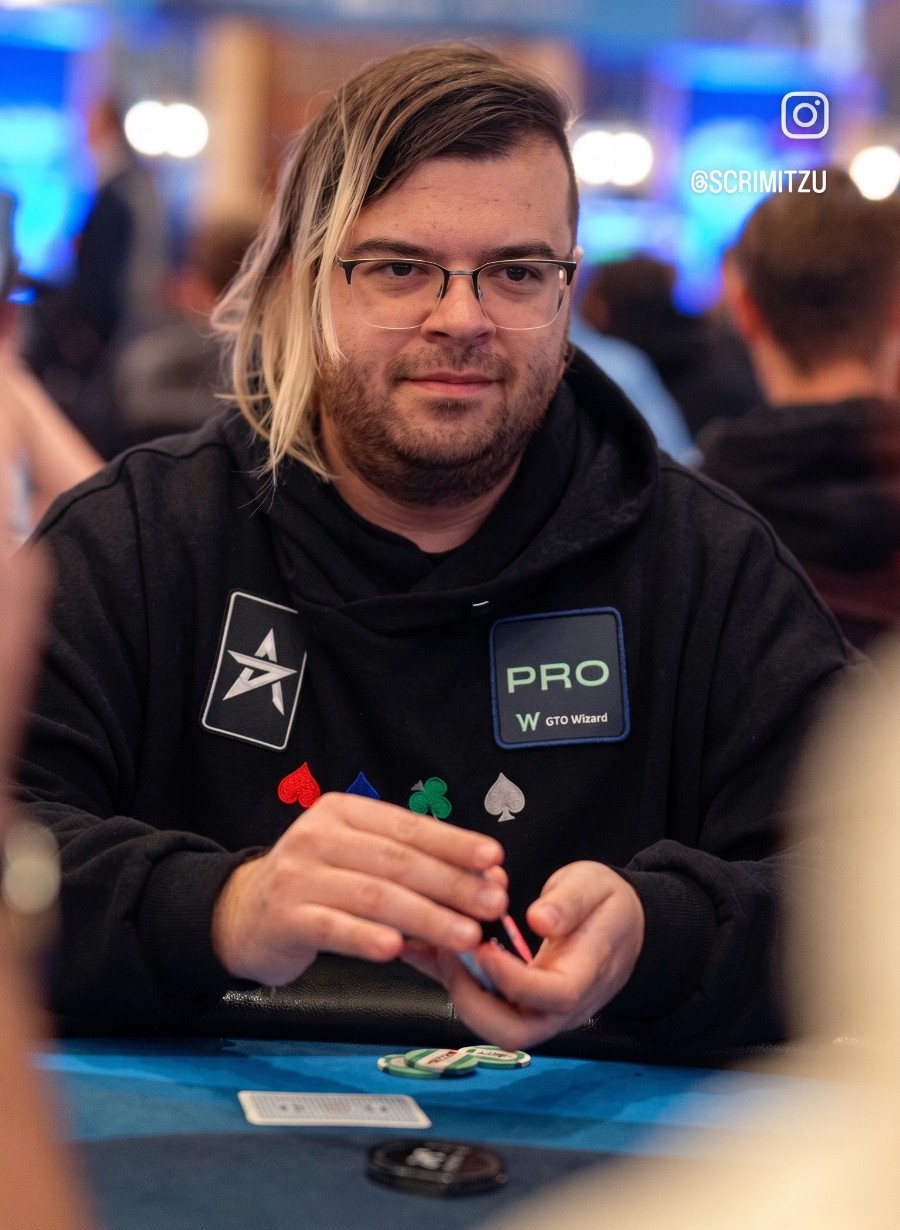
Scrimitzu is a professional poker player and coach with 17 years of experience and more than 10 million online hands played. He has coached over 500 players worldwide and is an official GTO Wizard coach and ACR Poker Team Online member.